

Chiropractic care for children: is it safe and when it helps
By Janice · Updated 2026-08-03

This is general information, not medical advice. Talk to your child’s pediatrician before starting chiropractic care, particularly if there’s an existing medical condition or the reason for seeking care isn’t clear.
Pediatric chiropractic care is its own specialty, not a smaller version of adult treatment, and that distinction matters more here than almost anywhere else in this field.
Why children need a different approach
A child’s spine and joints are still developing, and the forceful, high-velocity thrust techniques used on adults are not appropriate for a young child’s body. Practitioners trained in pediatric care use much gentler methods, often closer to a light, sustained pressure than a sharp adjustment, adapted specifically for a child’s size and developmental stage. This is the single most important thing to confirm before booking: that the practitioner has specific pediatric training, not just a general willingness to treat younger patients.
Common reasons parents seek it out
| Reason | What’s typically involved |
|---|---|
| Posture concerns from school bags or screen time | Gentle adjustment plus posture and ergonomic guidance |
| Growing pains or general discomfort | Assessment to rule out other causes, then gentle treatment |
| Sports-related aches in older children and teens | Similar approach to adult sports injury care, adapted for age |
| Early scoliosis screening | Assessment and monitoring, often alongside pediatric or orthopedic follow-up |
Chiropractic care for children is not intended to treat unrelated illnesses or general childhood conditions unconnected to the musculoskeletal system. If your child’s symptoms don’t clearly fit a posture, joint, or minor sports-injury pattern, a pediatrician’s assessment should come first.
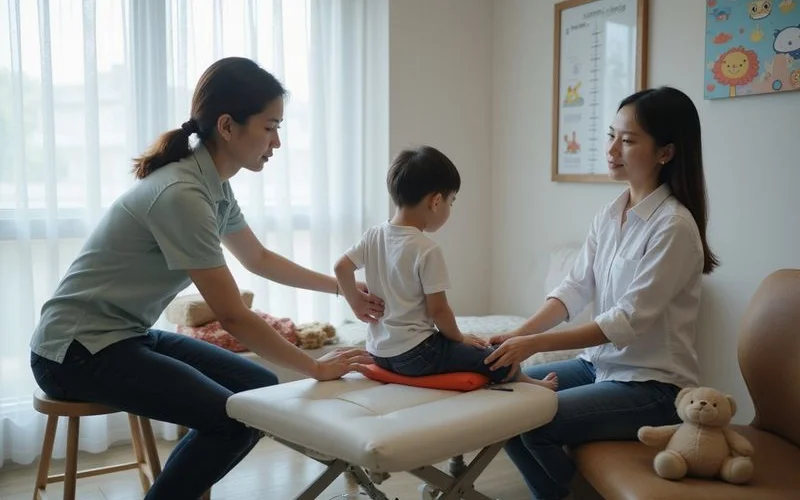
What a first visit typically looks like
A pediatric assessment usually starts slower and more conversationally than an adult one, giving your child time to get comfortable in the room before any hands-on examination begins. The practitioner will ask about your child’s activity level, any recent growth spurts, sports involvement, and how they’re carrying school bags or sitting during screen time, since these are common contributing factors. The physical check tends to be brief and gentle, focused on posture, spinal alignment, and range of motion, with plenty of explanation along the way so your child knows what’s happening at each step.
What to check before booking
Ask directly whether the practitioner has specific pediatric training, not just general chiropractic qualification, since the technique genuinely differs. Ask how they’ll explain the process to your child in an age-appropriate way, since a calm, unhurried approach matters for a child’s comfort during the visit. It’s also reasonable to ask to stay in the room throughout the session, and any practitioner experienced with children should welcome that. Finally, ask how many sessions they’d expect a case like your child’s to need, since pediatric plans are often shorter than adult ones given how quickly children’s bodies tend to respond.
Red flags
Be cautious of any practitioner who uses the same forceful technique on a child that they’d use on an adult, who can’t clearly explain how their approach differs for younger patients, or who discourages you from being present during treatment. None of these are acceptable adaptations for a child’s developing body.
Helping your child feel at ease
Children respond better to unfamiliar treatment when they understand what’s going to happen in terms they relate to, so it helps to ask the practitioner beforehand how they typically explain things to kids. Some clinics use simple demonstrations on a stuffed toy or the parent first, which can make the process feel less intimidating. If your child is anxious, mentioning this to the clinic before the visit gives them a chance to adjust their pace accordingly.
When to reassess the approach
If your child isn’t showing improvement after a reasonable number of sessions, or if they consistently seem uncomfortable or upset during treatment, that’s worth raising directly with the practitioner rather than continuing unchanged. A good pediatric practitioner welcomes this feedback and will adjust their approach or, if appropriate, suggest involving your child’s pediatrician for a broader assessment. If you’re also coordinating care for a grandparent or older family member, our guide on helping a parent with chronic back pain covers similar questions worth asking for older patients.
Getting started
If you’re considering pediatric chiropractic care for your child, start with a conversation about the practitioner’s specific training before booking a session. You can compare providers from the home page, and our methodology explains how we factor in specialised pediatric training when ranking clinics.
Common questions
- Is chiropractic adjustment safe for young children?
- When performed by a practitioner trained in pediatric technique, using gentle, low-force methods appropriate for a child's developing spine, it's generally considered safe. The technique used on an adult is not appropriate for a child, so training specific to pediatric care matters.
- What conditions do parents most often seek pediatric chiropractic care for?
- Common reasons include posture concerns, growing pains, sports-related discomfort in older children and teens, and general musculoskeletal complaints. It is not a treatment for unrelated childhood illnesses.
- How is a child's adjustment different from an adult's?
- Pressure is much lighter, often closer to a gentle push than the higher-velocity thrust used on adults, and techniques are adapted for a child's smaller frame and still-developing bone structure.
- Should I bring my child's pediatrician into the decision?
- Yes, particularly for anything beyond general posture or minor discomfort. Loop in your child's pediatrician, especially if there's an underlying condition or if symptoms are unclear.